Car Accessories Sourcing: 6 Categories That Ship Together
Car accessories are the easiest category to start sourcing and the most expensive to get wrong, because the products look simple, ship in volume, and fail for reasons that only appear after the container lands. A buyer who orders six categories from one supplier usually discovers that two of them share a carton problem, one has a fitment issue across model years, and one cannot legally be sold in the destination market without paperwork nobody mentioned.
This guide covers the six car-accessory categories that most commonly ship together, what each one needs before it can be packed into the same container, and where the hidden costs sit.

1. Lighting and bulbs
LED bulbs, work lights and tail-light replacements. Three things decide whether this category is smooth: socket standard (H4, H7, T10 and so on), whether the product is road-legal in the destination market, and whether the colour temperature matches what the packaging claims. Road legality is the trap — a bulb that is perfectly legal to import may be illegal to fit for road use, and the packaging carries the liability. Specify the socket, the colour temperature in kelvin, and the legal wording on the box before the order is placed.
2. Interior convenience electronics
Chargers, inverters, phone holders, dash accessories. This is where electrical safety and battery shipping rules collide. Anything with a lithium cell needs UN38.3 documentation and, for air freight, a test summary; anything that plugs into a 12V socket needs a fuse rated below the vehicle circuit's limit. Ask for the fuse rating and the input voltage range in writing. A 12V-only device sold into a market with 24V trucks will fail in the field and there is no way to fix it after the fact.
3. Fitment-dependent parts
Floor mats, seat covers, sun shades, cargo liners. These live or die on fitment data. A mat listed as fitting a model year range must actually match the floor pan for every year in that range, and model refreshes break this constantly. The practical approach is to narrow the claim to the years you have verified and to put the measurement on the listing. If a supplier cannot provide a fitment table with part numbers or dimensions, treat the product as universal-fit and price it accordingly — because customers will return it as universal-fit anyway.
4. Adhesives and exterior trim
Chrome trim, decals, badge emblems, door edge guards. The product is cheap; the adhesive is the product. Automotive double-sided tape behaves very differently across temperature ranges, and a trim piece that holds in a mild climate will lift at the first cold snap. Ask for the tape brand and the temperature range, not just "3M tape." Also confirm surface preparation instructions are included in the packaging, because most adhesion failures are installation failures.
5. Tools and emergency kits
Tyre inflators, jump starters, warning triangles, tow straps. Weight and battery rules dominate. A jump starter with a lithium pack is a dangerous-goods shipment and cannot travel by air without the full documentation; a warning triangle has to meet the destination country's standard, and standards differ. Get the standard number in writing before you print the carton.
6. Consumables and small parts
Wiper blades, air fresheners, cable ties, fuses. Low unit value, high volume, and the category that most often makes a mixed container work financially. They fill the gaps left by bulky items and they are the easiest to reorder. The risk is packaging damage rather than function — a carton of air fresheners crushed under a heavier pallet is a total loss, so these belong on top, not at the bottom.
How the six share one container
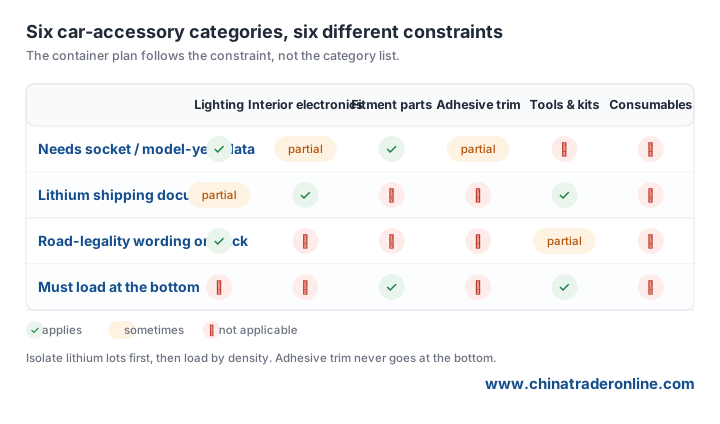
Two rules make a mixed car-accessory shipment work. First, separate by shipping constraint: anything with a lithium battery goes into its own documented lot, because it cannot be mixed freely and its paperwork must match the carton count. Second, load by density: heavy tools and mats at the bottom, lighting and trim in the middle, consumables on top, and nothing with adhesive at the bottom of a stack. Then confirm the carton count per SKU matches the commercial invoice line by line — customs disputes on mixed containers are almost always counting disputes.
Start with one category, verify the fitment or certification claim, and add the next on the following order. Our car accessories range spans lighting, interior electronics and emergency kit, so a first container can be built from a single supplier — for example this road-safety wake-up alarm alongside a 12V to 220V power inverter with USB output, both of which ship without lithium restrictions.
Sourcing products from China?
Send your product list and target quantity for a quote and a digital proof.
Get a free quoteRelated products
Wake-Up Alarmer driver Road Safety Warner BlackCTO64544
 75W Car 12V DC to 220V AC Power Inverter USB 5V PortCTO64545
 7443 7440 T20 27 LED 5050 SMD Tail Brake Light Bulb RedCTO64546
 H7 Low Beam New Super White Light Bulbs 6000K 2 Pcs Halogen Xenon 12V 55WCTO64547
 2 x T10 194 168 W5W 9-SMD Green 12V LED Car Wedge LightCTO64548